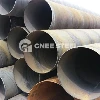
L245 steel pipe is a common low-grade pipeline steel manufactured according to standards like API 5L or ISO 3183. The "L" stands for "Line Pipe," and "245" indicates its minimum yield strength of 245 MPa (approximately 35,500 psi). It is a fundamental material in the energy and fluid transport sectors, known for its excellent balance of strength, weldability, and cost-effectiveness.
1. Primary Applications and Uses
L245 pipes are versatile and widely used in medium-to-low pressure environments. Their main applications include:
Used for gathering lines that transport crude oil or natural gas from wellheads to processing facilities. It is suitable for less aggressive environments.
A core material for urban and regional gas distribution systems, conveying processed natural gas to residential and commercial end-users.
Employed in large-diameter water mains and supply pipelines due to its good corrosion resistance when coated.
While not its primary purpose, L245 pipe is sometimes used in non-critical structural applications, foundation piling, and as casing for various construction projects.
Used in chemical plants, petrochemical complexes, and other industrial settings to move water, air, and other non-corrosive fluids.
2. Key Advantages and Benefits
The widespread adoption of L245 steel pipe is driven by several key advantages:
Cost-Effectiveness: As a low-grade steel with a simple chemical composition (primarily carbon-manganese), L245 is one of the most economical choices for large-scale pipeline projects, offering a low initial investment.
Its low carbon equivalent (CE) makes it easy to weld and fabricate in the field without requiring complex pre-heating or post-weld heat treatment procedures. This simplifies construction and reduces labor costs.
It possesses sufficient mechanical properties to withstand ground movement, minor impacts, and installation stresses without brittle fracture.
Being produced to globally recognized standards like API 5L ensures consistent quality, dimensional accuracy, and performance reliability from different manufacturers.
When combined with standard external coatings (e.g., FBE, 3LPE) and internal linings, it provides satisfactory service life for many common transport applications.
3. Future Development Prospects and Trends
While L245 represents a mature product, its future is shaped by evolving market demands and technological advancements:
Will continue to be a backbone material for building new energy infrastructure, including gas distribution networks in expanding cities.
Will see steady demand for the maintenance, replacement, and extension of existing pipeline networks.
Steelmakers will continue to optimize production processes (like Thermomechanical Controlled Processing - TMCP) to enhance the consistency, toughness, and dimensional precision of L245 pipes without significantly increasing cost.
The development of more durable and cost-effective coating systems will extend the service life of L245 pipelines, especially in mildly corrosive environments, keeping it competitive.
L245 will face increasing competition from High-Density Polyethylene (HDPE) pipes in the low-pressure distribution sector, particularly for gas and water, due to HDPE's superior corrosion resistance and flexibility.
Its market share will be defended by its higher pressure rating, temperature resistance, and mechanical rigidity compared to plastics.
For high-pressure, high-strength, and sour service (H₂S-containing) applications, the trend is moving towards higher-grade steels like L415/X60 and above.
Consequently, L245's primary role will solidify in low-to-medium pressure applications, non-sour service environments, where its cost-benefit ratio is optimal.
In summary, L245 steel pipe remains a vital and fundamental product in the global pipeline industry. Its compelling combination of ensures its continued relevance. While it will cede some ground to plastics in specific niches and to higher-grade steels in more demanding applications, its future is secure. It will continue to be the material of choice for a vast network of energy and water infrastructure worldwide, particularly in projects where economic efficiency is a primary driver.